Blog
AI-Driven Phishing Attacks: Smarter Scams, Bigger Risks, and How to Fight Back
Blog
AI-Driven Phishing Attacks: Smarter Scams, Bigger Risks, and How to Fight Back
The Problem: AI Is Supercharging Phishing Attacks
Phishing emails used to be riddled with spelling errors and sketchy links. They were easy to spot. Not anymore.
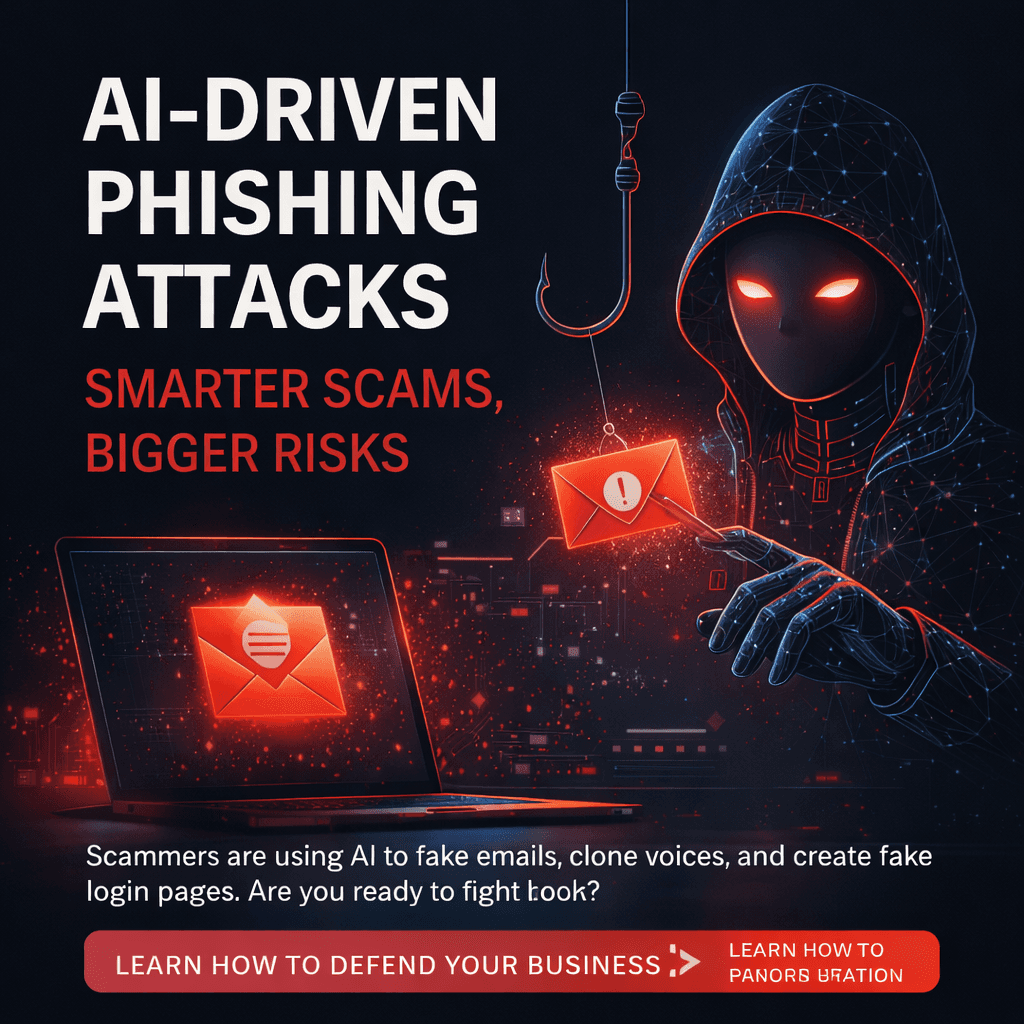
With AI, scammers can now:
Write personalized emails that mimic your writing style or company tone
Clone voices to leave fake voicemails from your CEO or clients
Spin up fake landing pages that mirror your real login portals
Launch attacks at scale across thousands of businesses in seconds
These attacks are more successful because they’re context-aware, grammatically perfect, and often indistinguishable from legitimate communication.
Real-World Examples:
An executive received a voice message from their "CEO" asking for an urgent transfer — it was a deepfake.
HR teams are being targeted by AI-generated resumes with malicious links.
Help desk emails that mimic internal language are tricking employees into resetting real passwords.
AI is removing the usual red flags — and businesses that rely on old training or filters are falling behind.
The Solution: Evolving Your Defense Strategy for AI Threats
To stay protected, businesses must shift from basic filters to intelligent, adaptive security systems — and train their people to think critically, not just react to checklists.
Here’s what that looks like:
1. Upgrade Your Email Security Stack
Modern phishing protection requires:
AI-powered email gateways that understand context and flag suspicious patterns
Link protection and sandboxing, so URLs are tested in a secure environment
Real-time threat intel integration to recognize zero-day phishing campaigns
2. Implement Multi-Factor Authentication (MFA) Across All Tools
Even if credentials are stolen, MFA prevents account access.
Prioritize apps with sensitive data (email, CRM, finance)
Avoid SMS-based MFA when possible — use authenticator apps or tokens
Regularly audit MFA coverage across the organization
3. Train Your People for Today’s Threats
Security awareness training must evolve too.
Teach employees how to analyze context, not just look for typos
Run AI-simulated phishing tests to replicate realistic threats
Encourage a zero-blame culture where reporting is easy and rewarded
4. Use EDR and User Behavior Analytics
Endpoint Detection & Response (EDR) can catch malicious attachments or activity
User behavior analytics can flag suspicious actions, even from “trusted” logins
Automate response protocols to shut down sessions before damage spreads
Why It Matters for SMBs and Mid-Market Companies
Big enterprises have security teams watching dashboards 24/7. Most SMBs don’t — and attackers know that.
That’s why:
60% of small businesses hit by phishing shut down within 6 months
Ransomware is often delivered via phishing first
AI allows attackers to scale “custom” scams without targeting big players
But here’s the good news: the same AI that empowers attackers can now empower defenders.
What Good Wolf Tech Provides
We help businesses stay ahead of evolving threats with:
AI-powered email filtering and phishing detection
Regular phishing simulations and employee training
Managed EDR and behavior monitoring
Strategic consulting on cyber hygiene and access policies
Tailored support for remote and hybrid environments
We serve companies across Metro Detroit and the Midwest who want real protection, not just another software subscription.
Final Word
AI has changed the phishing game — and the old rules no longer apply. Your employees won’t spot every threat. Your filters won’t catch every email.
But with the right combination of tools, training, and partners — your business doesn’t have to be an easy target.
➡️ Explore our cybersecurity services
➡️ Read more insights on the blog
Additional Reading
Looking for more insights? We recommend:
AI Is Supercharging Phishing Scams — Here’s What to Do | MIT Tech Review
Hashtags:
#MichiganTechSolutions #MetroDetroitITSupport #MidwestCybersecurity #DetroitTechExperts #BusinessTechMichigan #DigitalTransformation #AITechSolutions #CyberSecuritySolutions
The Problem: AI Is Supercharging Phishing Attacks
Phishing emails used to be riddled with spelling errors and sketchy links. They were easy to spot. Not anymore.
With AI, scammers can now:
Write personalized emails that mimic your writing style or company tone
Clone voices to leave fake voicemails from your CEO or clients
Spin up fake landing pages that mirror your real login portals
Launch attacks at scale across thousands of businesses in seconds
These attacks are more successful because they’re context-aware, grammatically perfect, and often indistinguishable from legitimate communication.
Real-World Examples:
An executive received a voice message from their "CEO" asking for an urgent transfer — it was a deepfake.
HR teams are being targeted by AI-generated resumes with malicious links.
Help desk emails that mimic internal language are tricking employees into resetting real passwords.
AI is removing the usual red flags — and businesses that rely on old training or filters are falling behind.
The Solution: Evolving Your Defense Strategy for AI Threats
To stay protected, businesses must shift from basic filters to intelligent, adaptive security systems — and train their people to think critically, not just react to checklists.
Here’s what that looks like:
1. Upgrade Your Email Security Stack
Modern phishing protection requires:
AI-powered email gateways that understand context and flag suspicious patterns
Link protection and sandboxing, so URLs are tested in a secure environment
Real-time threat intel integration to recognize zero-day phishing campaigns
2. Implement Multi-Factor Authentication (MFA) Across All Tools
Even if credentials are stolen, MFA prevents account access.
Prioritize apps with sensitive data (email, CRM, finance)
Avoid SMS-based MFA when possible — use authenticator apps or tokens
Regularly audit MFA coverage across the organization
3. Train Your People for Today’s Threats
Security awareness training must evolve too.
Teach employees how to analyze context, not just look for typos
Run AI-simulated phishing tests to replicate realistic threats
Encourage a zero-blame culture where reporting is easy and rewarded
4. Use EDR and User Behavior Analytics
Endpoint Detection & Response (EDR) can catch malicious attachments or activity
User behavior analytics can flag suspicious actions, even from “trusted” logins
Automate response protocols to shut down sessions before damage spreads
Why It Matters for SMBs and Mid-Market Companies
Big enterprises have security teams watching dashboards 24/7. Most SMBs don’t — and attackers know that.
That’s why:
60% of small businesses hit by phishing shut down within 6 months
Ransomware is often delivered via phishing first
AI allows attackers to scale “custom” scams without targeting big players
But here’s the good news: the same AI that empowers attackers can now empower defenders.
What Good Wolf Tech Provides
We help businesses stay ahead of evolving threats with:
AI-powered email filtering and phishing detection
Regular phishing simulations and employee training
Managed EDR and behavior monitoring
Strategic consulting on cyber hygiene and access policies
Tailored support for remote and hybrid environments
We serve companies across Metro Detroit and the Midwest who want real protection, not just another software subscription.
Final Word
AI has changed the phishing game — and the old rules no longer apply. Your employees won’t spot every threat. Your filters won’t catch every email.
But with the right combination of tools, training, and partners — your business doesn’t have to be an easy target.
➡️ Explore our cybersecurity services
➡️ Read more insights on the blog
Additional Reading
Looking for more insights? We recommend:
AI Is Supercharging Phishing Scams — Here’s What to Do | MIT Tech Review
Hashtags:
#MichiganTechSolutions #MetroDetroitITSupport #MidwestCybersecurity #DetroitTechExperts #BusinessTechMichigan #DigitalTransformation #AITechSolutions #CyberSecuritySolutions
The Problem: AI Is Supercharging Phishing Attacks
Phishing emails used to be riddled with spelling errors and sketchy links. They were easy to spot. Not anymore.
With AI, scammers can now:
Write personalized emails that mimic your writing style or company tone
Clone voices to leave fake voicemails from your CEO or clients
Spin up fake landing pages that mirror your real login portals
Launch attacks at scale across thousands of businesses in seconds
These attacks are more successful because they’re context-aware, grammatically perfect, and often indistinguishable from legitimate communication.
Real-World Examples:
An executive received a voice message from their "CEO" asking for an urgent transfer — it was a deepfake.
HR teams are being targeted by AI-generated resumes with malicious links.
Help desk emails that mimic internal language are tricking employees into resetting real passwords.
AI is removing the usual red flags — and businesses that rely on old training or filters are falling behind.
The Solution: Evolving Your Defense Strategy for AI Threats
To stay protected, businesses must shift from basic filters to intelligent, adaptive security systems — and train their people to think critically, not just react to checklists.
Here’s what that looks like:
1. Upgrade Your Email Security Stack
Modern phishing protection requires:
AI-powered email gateways that understand context and flag suspicious patterns
Link protection and sandboxing, so URLs are tested in a secure environment
Real-time threat intel integration to recognize zero-day phishing campaigns
2. Implement Multi-Factor Authentication (MFA) Across All Tools
Even if credentials are stolen, MFA prevents account access.
Prioritize apps with sensitive data (email, CRM, finance)
Avoid SMS-based MFA when possible — use authenticator apps or tokens
Regularly audit MFA coverage across the organization
3. Train Your People for Today’s Threats
Security awareness training must evolve too.
Teach employees how to analyze context, not just look for typos
Run AI-simulated phishing tests to replicate realistic threats
Encourage a zero-blame culture where reporting is easy and rewarded
4. Use EDR and User Behavior Analytics
Endpoint Detection & Response (EDR) can catch malicious attachments or activity
User behavior analytics can flag suspicious actions, even from “trusted” logins
Automate response protocols to shut down sessions before damage spreads
Why It Matters for SMBs and Mid-Market Companies
Big enterprises have security teams watching dashboards 24/7. Most SMBs don’t — and attackers know that.
That’s why:
60% of small businesses hit by phishing shut down within 6 months
Ransomware is often delivered via phishing first
AI allows attackers to scale “custom” scams without targeting big players
But here’s the good news: the same AI that empowers attackers can now empower defenders.
What Good Wolf Tech Provides
We help businesses stay ahead of evolving threats with:
AI-powered email filtering and phishing detection
Regular phishing simulations and employee training
Managed EDR and behavior monitoring
Strategic consulting on cyber hygiene and access policies
Tailored support for remote and hybrid environments
We serve companies across Metro Detroit and the Midwest who want real protection, not just another software subscription.
Final Word
AI has changed the phishing game — and the old rules no longer apply. Your employees won’t spot every threat. Your filters won’t catch every email.
But with the right combination of tools, training, and partners — your business doesn’t have to be an easy target.
➡️ Explore our cybersecurity services
➡️ Read more insights on the blog
Additional Reading
Looking for more insights? We recommend:
AI Is Supercharging Phishing Scams — Here’s What to Do | MIT Tech Review
Hashtags:
#MichiganTechSolutions #MetroDetroitITSupport #MidwestCybersecurity #DetroitTechExperts #BusinessTechMichigan #DigitalTransformation #AITechSolutions #CyberSecuritySolutions
Related Blogs
Check our other blogs with useful insight and information for your business.



Related Blogs
Check our other blogs with useful insight and information for your business.