Blog
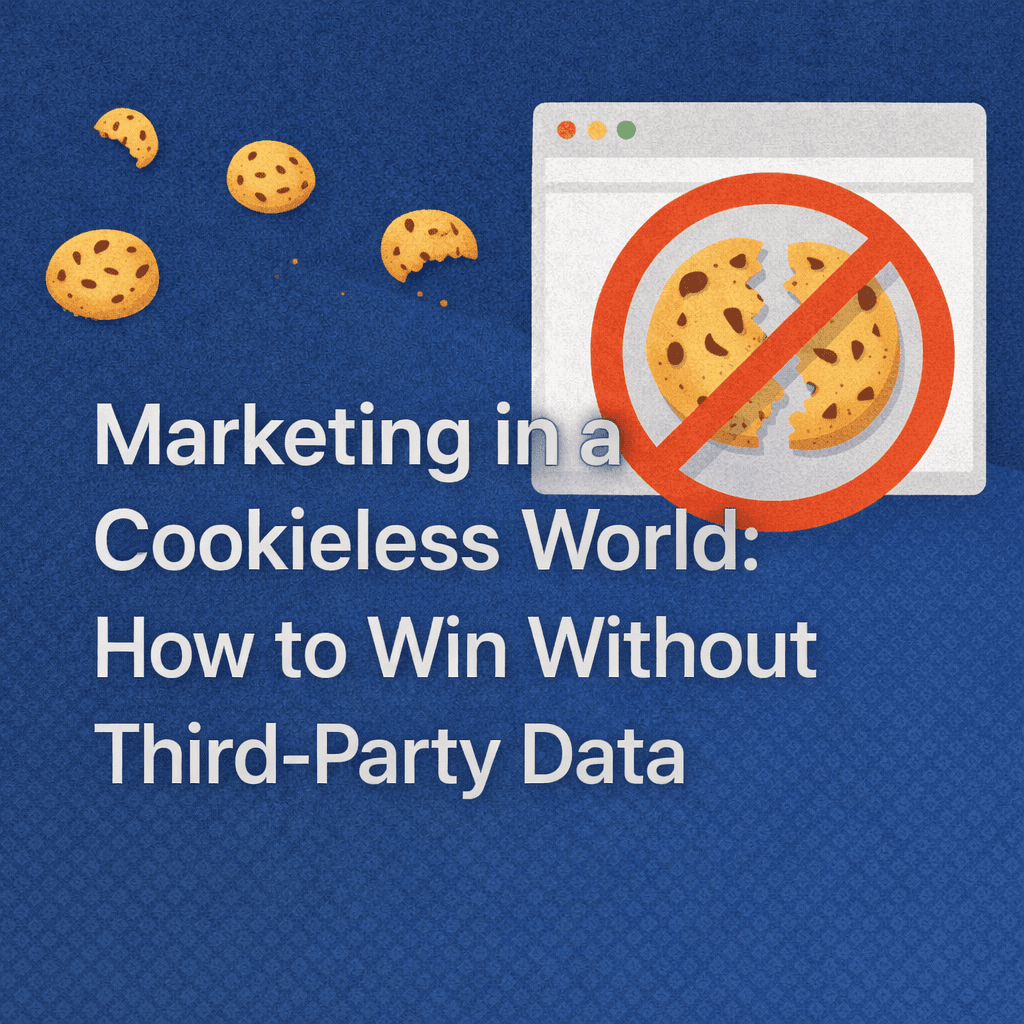
Marketing in a Cookieless World: How to Win Without Third-Party Data
Blog
Marketing in a Cookieless World: How to Win Without Third-Party Data
The Problem: Your Ads Just Lost Their Superpower
For years, third-party cookies were the backbone of digital marketing. They allowed brands to:
Track users across websites
Serve hyper-targeted ads
Retarget abandoned carts
Attribute conversions with pixel-level accuracy
But in 2025, that power is gone — or rapidly disappearing.
Google Chrome has started phasing out third-party cookies
Apple’s iOS tracking restrictions continue to limit app data
Regulators are enforcing stronger data privacy standards globally
Ad platforms are less effective without personal behavior tracking
If your paid media, email funnels, or retargeting strategies still rely on third-party data — you’re flying blind.
Why This Matters for Small and Mid-Sized Businesses
It’s not just a “big brand” issue. Local companies and niche eCommerce stores are feeling the impact:
Facebook/Meta ads not converting like they used to
Retargeting audiences shrinking
Attribution data becoming unreliable
Higher costs for lower-performing ads
This shift isn’t temporary — it’s the new normal.
The Solution: Build a First-Party Data Strategy Now
The most successful brands in the cookieless world are doing one thing really well:
They’re owning their data.
Instead of relying on third-party sources, they're collecting, organizing, and activating their own audience insights — with full transparency.
Here’s how to do it:
1. Double Down on First-Party Data Collection
First-party data = information you collect directly from your customers.
Examples:
Email addresses from gated content
Phone numbers from SMS opt-ins
Purchase behavior on your own website
Form submissions and surveys
✅ Use lead magnets, pop-ups, quizzes, and gated tools to gather quality data
✅ Be transparent — let people know how you’ll use it to improve their experience
2. Leverage CRM and CDP Platforms
Don’t just collect — organize.
Use tools like:
HubSpot, Klaviyo, or Mailchimp for email and behavior tracking
Segment or Customer.io for advanced segmentation and workflows
A well-tagged CRM allows you to personalize communication, build segmented audiences, and track performance without violating privacy.
3. Use Contextual Targeting Instead of Behavioral
We covered this recently, but it’s worth repeating:
Contextual ads place your content next to relevant topics — not based on personal tracking.
Example:
Your landscaping ad appears on a DIY patio blog post
Your productivity app is advertised on a podcast about remote work
Contextual ads are:
Privacy-safe
Lower cost
High-intent when aligned correctly
4. Use Consent-Based Retargeting Tactics
Old retargeting based on cross-site behavior? Not reliable anymore.
New approach:
Build custom audiences from your email list or site traffic
Use server-side tracking and conversion APIs to fill attribution gaps (e.g., Meta CAPI or GA4)
Focus on high-intent actions (e.g., “Viewed Pricing Page” or “Abandoned Cart”)
5. Offer Value in Exchange for Access
Want more emails, phone numbers, and customer data?
Give something first:
Free checklist or guide
Interactive calculator or tool
Exclusive access to discounts
Loyalty program or VIP access
This is how you grow owned data with consent — and that’s key in 2025.
Who This Impacts Most
✅ Local service businesses using Google or Facebook Ads
✅ E-commerce brands with high cart abandonment
✅ B2B companies relying on LinkedIn and email campaigns
✅ Any brand not already collecting and using its own data
Your Next Move: Take Control of Your Data
At Good Wolf Marketing, we help brands transition to a privacy-safe strategy that still gets results.
We’ll audit your current setup
Help implement first-party data collection
Rebuild your audience funnels
Set up server-side tracking to future-proof your ads
Learn more about what’s changing — and how to adapt — on the Good Wolf Blog
Hashtags:
#digitalmarketingagency #digitalmarketingservices #paidads #onlinemarketing #MetroDetroitMarketing #MichiganMarketingAgency #MarketingStrategy #digitalmarketingtrends #BrandVisibility #DetroitMarketingAgency
Authoritative Source:
Think with Google – The Future is First-Party: Navigating Marketing in a Privacy-First World
The Problem: Your Ads Just Lost Their Superpower
For years, third-party cookies were the backbone of digital marketing. They allowed brands to:
Track users across websites
Serve hyper-targeted ads
Retarget abandoned carts
Attribute conversions with pixel-level accuracy
But in 2025, that power is gone — or rapidly disappearing.
Google Chrome has started phasing out third-party cookies
Apple’s iOS tracking restrictions continue to limit app data
Regulators are enforcing stronger data privacy standards globally
Ad platforms are less effective without personal behavior tracking
If your paid media, email funnels, or retargeting strategies still rely on third-party data — you’re flying blind.
Why This Matters for Small and Mid-Sized Businesses
It’s not just a “big brand” issue. Local companies and niche eCommerce stores are feeling the impact:
Facebook/Meta ads not converting like they used to
Retargeting audiences shrinking
Attribution data becoming unreliable
Higher costs for lower-performing ads
This shift isn’t temporary — it’s the new normal.
The Solution: Build a First-Party Data Strategy Now
The most successful brands in the cookieless world are doing one thing really well:
They’re owning their data.
Instead of relying on third-party sources, they're collecting, organizing, and activating their own audience insights — with full transparency.
Here’s how to do it:
1. Double Down on First-Party Data Collection
First-party data = information you collect directly from your customers.
Examples:
Email addresses from gated content
Phone numbers from SMS opt-ins
Purchase behavior on your own website
Form submissions and surveys
✅ Use lead magnets, pop-ups, quizzes, and gated tools to gather quality data
✅ Be transparent — let people know how you’ll use it to improve their experience
2. Leverage CRM and CDP Platforms
Don’t just collect — organize.
Use tools like:
HubSpot, Klaviyo, or Mailchimp for email and behavior tracking
Segment or Customer.io for advanced segmentation and workflows
A well-tagged CRM allows you to personalize communication, build segmented audiences, and track performance without violating privacy.
3. Use Contextual Targeting Instead of Behavioral
We covered this recently, but it’s worth repeating:
Contextual ads place your content next to relevant topics — not based on personal tracking.
Example:
Your landscaping ad appears on a DIY patio blog post
Your productivity app is advertised on a podcast about remote work
Contextual ads are:
Privacy-safe
Lower cost
High-intent when aligned correctly
4. Use Consent-Based Retargeting Tactics
Old retargeting based on cross-site behavior? Not reliable anymore.
New approach:
Build custom audiences from your email list or site traffic
Use server-side tracking and conversion APIs to fill attribution gaps (e.g., Meta CAPI or GA4)
Focus on high-intent actions (e.g., “Viewed Pricing Page” or “Abandoned Cart”)
5. Offer Value in Exchange for Access
Want more emails, phone numbers, and customer data?
Give something first:
Free checklist or guide
Interactive calculator or tool
Exclusive access to discounts
Loyalty program or VIP access
This is how you grow owned data with consent — and that’s key in 2025.
Who This Impacts Most
✅ Local service businesses using Google or Facebook Ads
✅ E-commerce brands with high cart abandonment
✅ B2B companies relying on LinkedIn and email campaigns
✅ Any brand not already collecting and using its own data
Your Next Move: Take Control of Your Data
At Good Wolf Marketing, we help brands transition to a privacy-safe strategy that still gets results.
We’ll audit your current setup
Help implement first-party data collection
Rebuild your audience funnels
Set up server-side tracking to future-proof your ads
Learn more about what’s changing — and how to adapt — on the Good Wolf Blog
Hashtags:
#digitalmarketingagency #digitalmarketingservices #paidads #onlinemarketing #MetroDetroitMarketing #MichiganMarketingAgency #MarketingStrategy #digitalmarketingtrends #BrandVisibility #DetroitMarketingAgency
Authoritative Source:
Think with Google – The Future is First-Party: Navigating Marketing in a Privacy-First World
The Problem: Your Ads Just Lost Their Superpower
For years, third-party cookies were the backbone of digital marketing. They allowed brands to:
Track users across websites
Serve hyper-targeted ads
Retarget abandoned carts
Attribute conversions with pixel-level accuracy
But in 2025, that power is gone — or rapidly disappearing.
Google Chrome has started phasing out third-party cookies
Apple’s iOS tracking restrictions continue to limit app data
Regulators are enforcing stronger data privacy standards globally
Ad platforms are less effective without personal behavior tracking
If your paid media, email funnels, or retargeting strategies still rely on third-party data — you’re flying blind.
Why This Matters for Small and Mid-Sized Businesses
It’s not just a “big brand” issue. Local companies and niche eCommerce stores are feeling the impact:
Facebook/Meta ads not converting like they used to
Retargeting audiences shrinking
Attribution data becoming unreliable
Higher costs for lower-performing ads
This shift isn’t temporary — it’s the new normal.
The Solution: Build a First-Party Data Strategy Now
The most successful brands in the cookieless world are doing one thing really well:
They’re owning their data.
Instead of relying on third-party sources, they're collecting, organizing, and activating their own audience insights — with full transparency.
Here’s how to do it:
1. Double Down on First-Party Data Collection
First-party data = information you collect directly from your customers.
Examples:
Email addresses from gated content
Phone numbers from SMS opt-ins
Purchase behavior on your own website
Form submissions and surveys
✅ Use lead magnets, pop-ups, quizzes, and gated tools to gather quality data
✅ Be transparent — let people know how you’ll use it to improve their experience
2. Leverage CRM and CDP Platforms
Don’t just collect — organize.
Use tools like:
HubSpot, Klaviyo, or Mailchimp for email and behavior tracking
Segment or Customer.io for advanced segmentation and workflows
A well-tagged CRM allows you to personalize communication, build segmented audiences, and track performance without violating privacy.
3. Use Contextual Targeting Instead of Behavioral
We covered this recently, but it’s worth repeating:
Contextual ads place your content next to relevant topics — not based on personal tracking.
Example:
Your landscaping ad appears on a DIY patio blog post
Your productivity app is advertised on a podcast about remote work
Contextual ads are:
Privacy-safe
Lower cost
High-intent when aligned correctly
4. Use Consent-Based Retargeting Tactics
Old retargeting based on cross-site behavior? Not reliable anymore.
New approach:
Build custom audiences from your email list or site traffic
Use server-side tracking and conversion APIs to fill attribution gaps (e.g., Meta CAPI or GA4)
Focus on high-intent actions (e.g., “Viewed Pricing Page” or “Abandoned Cart”)
5. Offer Value in Exchange for Access
Want more emails, phone numbers, and customer data?
Give something first:
Free checklist or guide
Interactive calculator or tool
Exclusive access to discounts
Loyalty program or VIP access
This is how you grow owned data with consent — and that’s key in 2025.
Who This Impacts Most
✅ Local service businesses using Google or Facebook Ads
✅ E-commerce brands with high cart abandonment
✅ B2B companies relying on LinkedIn and email campaigns
✅ Any brand not already collecting and using its own data
Your Next Move: Take Control of Your Data
At Good Wolf Marketing, we help brands transition to a privacy-safe strategy that still gets results.
We’ll audit your current setup
Help implement first-party data collection
Rebuild your audience funnels
Set up server-side tracking to future-proof your ads
Learn more about what’s changing — and how to adapt — on the Good Wolf Blog
Hashtags:
#digitalmarketingagency #digitalmarketingservices #paidads #onlinemarketing #MetroDetroitMarketing #MichiganMarketingAgency #MarketingStrategy #digitalmarketingtrends #BrandVisibility #DetroitMarketingAgency
Authoritative Source:
Think with Google – The Future is First-Party: Navigating Marketing in a Privacy-First World
Related Blogs
Check our other blogs with useful insight and information for your business.


Related Blogs
Check our other blogs with useful insight and information for your business.